

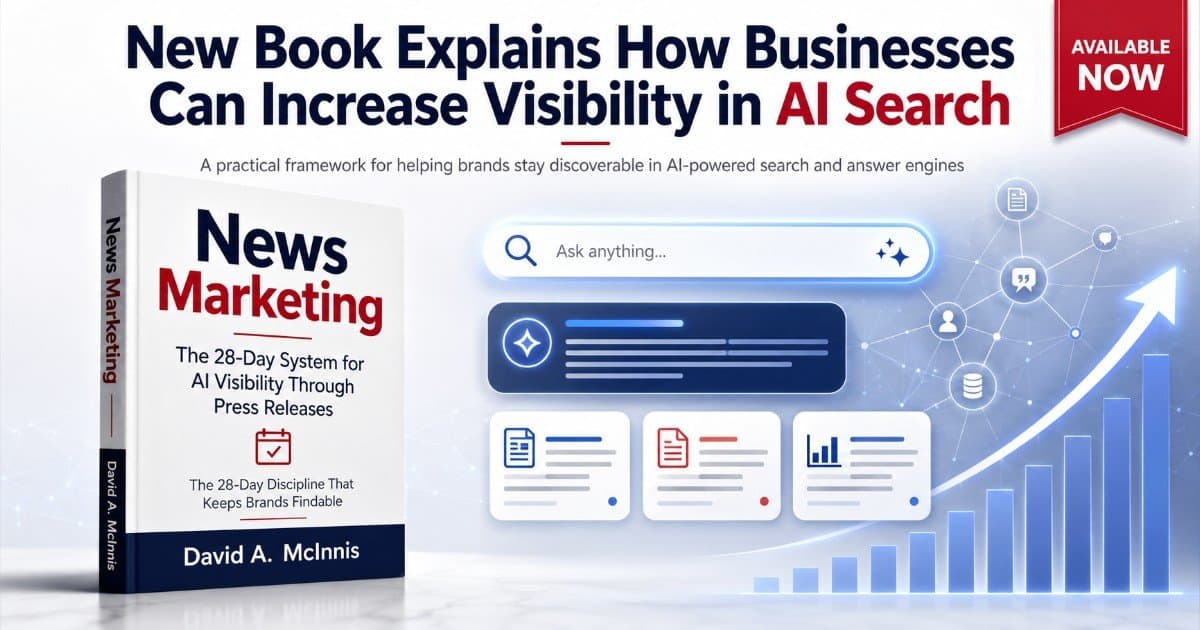
David A. McInnis, a news marketing pioneer and author, today announced the release of News Marketing: The 28-Day System for AI Visibility Through Press Releases, a new book designed to help businesses, marketers, communicators, and public relations professionals adapt to the rapidly changing landscape of AI-powered information discovery. As platforms such as ChatGPT, Google AI Overviews, Perplexity, Claude, Copilot, and Gemini increasingly shape how people find and consume information online, organizations face a new challenge: ensuring their expertise, products, services, and announcements are visible within AI-generated answers.
News Marketing: The 28-Day Discipline That Keeps Brands Findable presents a practical framework for addressing that challenge by helping organizations understand how AI systems retrieve information, evaluate sources, recognize entities, and surface content in response to user questions. The book introduces concepts including AI visibility, retrieval assets, entity authority, knowledge graphs, schema markup, and the role of news-driven content in modern digital discoverability.
“Many organizations are still operating with visibility strategies built for an earlier era of the internet,” said McInnis. “The rise of AI-powered search and answer engines is changing how information is discovered. This book provides a practical framework for understanding those changes and adapting to them.”
The book outlines a repeatable 28-day publishing system designed to help organizations create structured, discoverable content that can support long-term visibility across traditional search engines and emerging AI retrieval systems. It explores how content assets like news releases, when properly structured and amplified, can serve as durable digital assets that contribute to brand discoverability long after publication.
Topics covered include how AI systems retrieve and evaluate information, the differences between AI training, grounding, and retrieval, the role of entity authority and knowledge graphs, schema markup and structured data best practices, AI visibility, AIO, GEO, and evolving search behaviors, the 28-Day Rule for maintaining newsworthiness and discoverability, and building long-term visibility through news-driven content strategies.
News Marketing: The 28-Day System for AI Visibility Through Press Releases is available now in paperback and Kindle editions on Amazon.
Marketers and PR professionals who download the book also gain free access to the AI ChunkTool, a companion web application available at chunktool.newsmarketingbook.com that lets writers see their copy the way AI does. ChunkTool analyzes any pasted text and maps exactly where AI retrieval systems will slice it into chunks, comparing six industry-standard chunking strategies side by side, from fixed token windows to paragraph and semantic splitting. Writers can instantly verify that key claims and brand messages survive intact inside a single chunk, check whether any critical phrase gets severed at a chunk boundary, and receive a full emailed report of the analysis.
To learn more about the book or download a complimentary digital edition, visit News Marketing Book - The Online Visibility Program for AI and SEO.
The implications of this book for the publishing industry are significant. As AI-driven search becomes the primary way consumers and professionals find information, traditional press release strategies may become obsolete. Companies that fail to adapt risk being invisible in AI-generated answers, potentially losing market share to competitors who optimize for these systems. The 28-day system offers a disciplined approach to maintaining discoverability, emphasizing consistent, structured content that aligns with how AI retrieval engines work.
This news matters because it provides a tangible methodology for an abstract problem. For marketers and PR professionals, the book offers a roadmap to navigate the shift from traditional search engine optimization (SEO) to AI visibility (AIO) and generative engine optimization (GEO). The inclusion of the AI ChunkTool is particularly noteworthy, as it addresses a common pain point: ensuring that critical information is not lost when AI systems break content into smaller pieces for retrieval.
